Understanding the Periodic Table of Elements Word Search
What Makes This Word Search Collection Stand Out
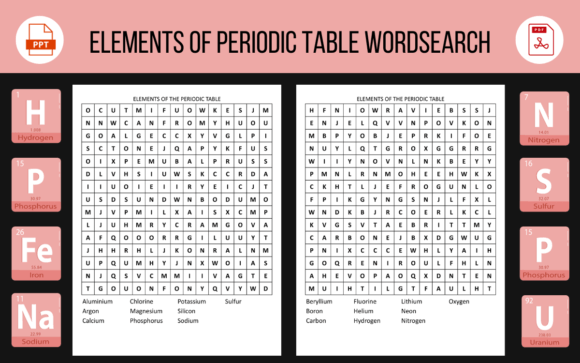
Chemistry-themed puzzles occupy a specific but persistent niche in educational publishing and activity book creation. A word search built around the entire list of 118 recognized elements moves beyond simple entertainment into a resource that quietly reinforces scientific vocabulary. The Periodic Table of Elements Word Search package delivers exactly that: a focused collection of puzzles where every answer is a chemical element, from hydrogen to oganesson. The download includes a 27-page interior ready for print, with each puzzle occupying its own page and a solutions section following the puzzles. This structure respects a fundamental publishing principle: if puzzle and solution sit on separate sheets, the user experience stays clean.
What gives the file its practical edge is the completeness. Instead of picking 40 or 50 common elements, the puzzle grid pulls from the full 118-word bank. That full coverage serves two audiences well. For science teachers, it means students encounter lesser-known elements such as ytterbium or darmstadtium, sparking curiosity beyond the textbook’s first twenty. For adult puzzle book compilers, it offers a self-contained theme that doesn’t require supplementing. The puzzle design keeps a standard layout—letters in a grid, words placed horizontally, vertically, and diagonally—which readers instantly recognize and find comfortable.
Technical Specifications and Print Quality
The numbers matter when a file moves from screen to paper. These assets are built at 8.5 x 11 inches with 300 DPI, a resolution that holds up under professional printing. At that dot density, lines stay crisp and letters remain readable even when the grid is dense. The no bleed setting simplifies the upload process for print-on-demand platforms like Amazon KDP. Because nothing extends past the trim edge, you avoid rejection messages that bleed format mismatches often trigger. Designers familiar with KDP’s interior requirements will recognize this as a time-saving advantage right from the download folder.
The file formats mirror what working creators actually need. You receive a PDF that can be uploaded with minimal intervention, a PPT file for anyone who wants to adjust puzzles or branding, and a PNG file that serves as a quick preview or a layer for mockups. The 27-page count accounts for both puzzles and solutions. Since each puzzle is confined to one page, the grid never feels cramped. Surrounding white space prevents the heavy visual load that sometimes makes word searches tiring to scan, especially for adults who use them as a focus exercise.
Who Finds the Most Value in This Download
The obvious beneficiaries are print-on-demand publishers building a catalog of activity books. A chemistry word search occupies a sweet spot: not so broad that it drowns in generic puzzle competition, yet recognizable enough that customers searching for “science puzzle book” will find it. For a creator who runs multiple niche imprints, a ready-made interior can drastically cut turnaround time. Instead of designing grids and verifying word lists from scratch, you spend your energy on cover design, keywords, and marketing—tasks that directly influence visibility.
School teachers and homeschooling parents make up another core group. In a classroom, a printed word search offers a low-stakes vocabulary builder. Because the puzzle uses all 118 elements, it can support a periodic table unit over several sessions. A teacher might assign three puzzles across a week, with each batch covering a different group of elements. The fact that solutions are included means no separate answer key needs to be typed up. Science camp coordinators, library event planners, and after-school program leaders will likely see similar usefulness.
Adult hobbyists and puzzle enthusiasts shouldn’t be overlooked. Many people turn to word searches as a way to disconnect from screens and reset mentally. A Periodic Table of Elements Word Search adds a layer of intellectual engagement because the words are less predictable than everyday vocabulary. Finding “praseodymium” in a grid feels more satisfying than locating “apple” or “chair,” and it subtly reinforces science literacy at any age.
Editable PPT File: Customization and Branding Flexibility
While the PDF provides a locked final version, the PowerPoint file opens up substantial creative control. You can insert a header with a website URL, add a brief instruction line, or adjust the puzzle font to match a series style. If you want to create themed bundles—like a “Women in Science” puzzle book that includes this word search as a chapter—you can add a contextual paragraph or a fun fact at the bottom of each page. The editable format also lets you modify difficulty. For younger audiences, you might reduce the diagonal placements; for advanced solvers, you could scatter extra filler letters that form a hidden phrase. This flexibility transforms a static download into a modular component that adapts to different products over time.
Branding becomes more subtle but equally important. A publisher who sells under multiple pen names can personalize the interior slightly for each brand without rebuilding puzzles. A tutoring center can add its logo and contact information, then print copies as promotional material. Because the puzzle itself remains the core value, the edits feel like enhancements rather than heavy redesigns.
Real-World Performance on Amazon KDP
When you upload the PDF to KDP, the no-bleed specification and standard paper size work in your favor. The interior reviewer checks for margins and text cut-off, and a file already built to trim dimensions passes those checks with fewer corrections. Many first-time publishers underestimate how often bleed settings cause rejections, so having a clean interior file removes a predictable friction point.
Customer perception once the book is printed also hinges on print quality. A 300 DPI source prevents the fuzzy edge that makes solve grids look cheap. Because each puzzle is one page, the book opens flat without puzzles crossing the gutter. Solutions appear in a clear section at the back, so readers are not tempted to glance unintentionally while solving. In the competitive activity book market, these small polish points can influence whether a buyer leaves a positive review or returns a book that feels slapped together.
One practical consideration: the 27-page count might feel thin for a standalone paperback. Many successful puzzle books run 80 to 120 pages. Creators often solve this by combining the word search with additional chemistry content—crosswords, trivia pages, element fact sheets, or coloring elements. Because the file is a single component, it works best when you treat it as a chainable asset rather than a complete book in isolation. This is not a weakness of the puzzle design itself, but a strategic call for any publisher evaluating page-count expectations.
Balancing Strengths and Limitations
No resource is universally perfect, and pointing out boundaries helps buyers align expectations. The puzzles focus solely on word search format, with no built-in variety like cryptograms or matching exercises. If you need a multifaceted chemistry activity book, you will be pulling in additional content sources. The word list is exhaustive but may feel repetitive to a solver who completes all puzzles in one sitting; the same 118 elements appear across multiple grids arranged differently. That repetition serves learning but could reduce replay value for a casual user purchasing a single book.
Layout consistency is a strength, yet some publishers might prefer a more decorative design with icons or borders. The interior is clean and functional rather than decorative. For a science-themed book, that minimalism often works because it keeps focus on the elements, but sellers aiming for a highly stylized aesthetic will need to invest time in the PPT file to embellish pages. The download does not include a cover file, which is standard for interior assets but worth noting: you still need to design or commission a cover separately.
From an educational standpoint, the puzzle helps with recognition and spelling of element names but does not teach atomic numbers, symbols, or groups. A teacher should pair it with a periodic table reference or a short factsheet. That is not a flaw; it simply positions the word search as a complementary tool rather than a primary instructional resource.
Long-Term Value for Publishers and Educators
A well-structured puzzle interior stays relevant across years because the periodic table itself does not change arbitrarily. Unlike trend-based activity books that date quickly, chemistry puzzles retain their evergreen appeal. Once you integrate the file into a product, you can keep it listed indefinitely without updating content. For a publisher who values library-building over chasing fads, that stability translates into passive income potential.
The editable PPT format multiplies long-term usability. Over time, you might extract a few puzzles for a free lead magnet, use a grid in a video workshop, or compile a “science puzzles” mega-bundle. Because you hold the source file, you are not locked into a single product. Tutors can reprint puzzles for different cohorts. Bloggers can convert a page into a printable post. The 300 DPI resolution ensures that whatever direction you take, the visual quality remains intact.
For a modest price point often associated with ready-to-upload puzzle interiors, the value proposition sits firmly on time savings and production safety. You avoid the tedious process of generating word search grids that correctly incorporate all 118 element names without errors. The file handles that technical burden, and the included solutions eliminate the manual answer-checking that consumes hours. Professionals who understand their hourly rate will recognize the math quickly.
Practical Recommendations for Getting the Most Out of the Files
If you intend to publish on Amazon KDP, your first step should be to review the interior using the Kindle Previewer or a printed proof copy. Check that the font renders properly at small sizes and that the solutions section is clearly separated. Because the PDF is print-ready, you should be able to upload and order a proof within minutes, which allows you to assess the physical product before investing further in marketing.
For those who want a thicker book, consider adding 10 to 15 pages of related content in the editable PPT before exporting a new PDF. A brief page explaining element groups, a fun fact corner, or a “color the element symbol” activity can stretch the page count while adding perceived value. Since the puzzle pages are already formatted, you are simply extending the book block, not redesigning the core.
The PNG file is often overlooked but useful for creating product mockups, Etsy listing images, or social media previews. You can overlay the puzzle grid onto a tablet mockup to show how the digital printable version looks on a screen. This visual flexibility helps market the product without needing to photograph a physical book in advance.
When you assess whether this puzzle collection fits your workflow, weigh your need for speed against your desire for a fully custom product. If you want to launch a chemistry puzzle book within a few days and value print reliability, the package removes many technical barriers. If you plan to heavily theme each page with scientific illustrations or unique formatting, you will still use the files but must invest editing time. Either scenario benefits from a download that starts from a professionally measured baseline rather than a blank artboard.