Smart Attendance Register Book for Teacher KDP Publishing
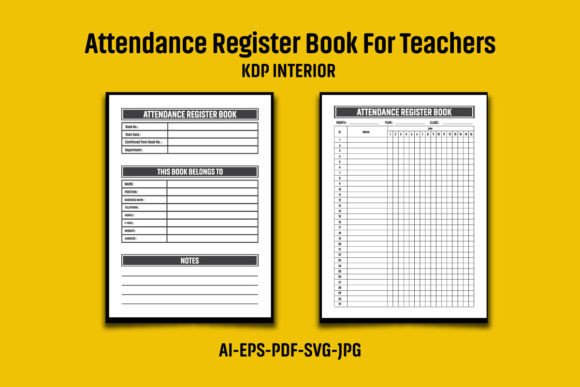
If you’ve ever searched for niche KDP interiors that solve a real classroom problem, the Attendance Register Book for Teacher KDP sits at that exact intersection. It’s not simply another blank log. It’s a carefully structured 120-page layout delivered as a complete interior package: 8.5″x11″ with bleed, high-resolution 300 DPI, and multiple file formats ready for Adobe Illustrator, Photoshop, or direct PDF editing. The real value, however, lies in how you adapt it—turning a functional attendance tracker into a beloved teacher resource that sells repeatedly.
For self-publishers, freelancers, and side-hustle entrepreneurs, this interior solves the biggest pain point: creating something that looks professional without spending days on margins, gutters, and alignment. The files arrive as one compressed ZIP, containing AI, EPS, PDF, JPG, and SVG assets. That’s immediate flexibility. You unzip, choose your editing software, and start personalizing. But what makes it genuinely interesting isn’t the file list. It’s the sheer number of creative directions a single template can take.
Why the Classic Teacher Attendance Register Remains in Demand
Digital roll-call apps exist, but thousands of teachers still prefer paper registers. Walk through any elementary school, tutoring center, homeschool co-op, or Montessori environment and you’ll notice a simple truth: paper provides tactile reassurance. It works when Wi-Fi drops. It doesn’t require updates. It keeps a permanent, handwriting-friendly archive that many administrators need for compliance.
The Attendance Register Book For Teachers KDP Interior taps into that demand without locking you into a single style. Because the interior is delivered as unflattened editable files, you can adjust fonts, tweak table line weights, add grade-level icons, or even reshape the entire column logic. This transforms a basic attendance log into a tailored product you can brand and publish under your own name.
Creative Approaches to Make Your Register Stand Out
Publishing an attendance book might sound straightforward, but the difference between a title that earns fifty cents a month and one that becomes a steady seller often comes down to how you frame the experience. Think beyond “Name, Date, Present, Absent.”
- Add a student snapshot section. Dedicate a small box beside each name line where teachers can jot a quick learning observation, reading group level, or social-emotional note. This turns the register into a daily reflection tool.
- Introduce monthly or seasonal headers. Use subtle themed line art (nothing that overwhelms the black-and-white print) to separate months. A tiny apple, a leaf, a snowflake. Teachers adore small seasonal touches that keep record-keeping fresh.
- Integrate a permission slip tracker. On the same spread, add a compact checklist for field trip forms, photo releases, or medication permissions. Combining two related tasks reduces the number of notebooks a teacher carries.
- Design a dual-purpose grade book. Pair attendance with a small assessment grid. The left page tracks who attended; the right page captures a quick quiz score or participation mark. This contextual data is gold for parent-teacher conferences.
All of these adjustments become possible because you’re starting from a base that gives you full access to the original vectors, not a locked PDF. Changing colors is equally straightforward: the black-and-white interior keeps printing costs low, but within the AI or EPS files, you can softly tint header strips to match a school’s color palette or a specific cover design.
Customizing the 8.5″x11″ Format for Specific Teaching Niches
Generic registers often fail because they try to suit every classroom. Smart publishers flip that logic. Use the same interior structure to build focused sub-niches, each with its own cover and minor internal tweaks. The 8.5″x11″ trim size with bleed (overall dimensions 8.62 x 11.25 inches) gives you ample space to play without crowding the table.
- Preschool and daycare version. Enlarge the name cells. Add smiley face checkboxes for half-day attendance, nap time participation, and meal tracking. Preschool teachers record more than just presence; they track routines. Your register can reflect that.
- Homeschool portfolio register. Homeschool parents often need to submit attendance logs to state authorities. Create a version with a year-at-a-glance overview page, subject activity columns, and a footer for parent initials. This adds legal compliance value.
- Substitute teacher quick-log. Subs walk into chaos. A register that includes a “notes for the regular teacher” column, a seating chart mini-grid, and simplified check-in/check-out times makes their day smoother. Title it “Substitute Attendance and Classroom Log.”
- Special education caseload tracker. IEP minutes, related services, behavioral notes—these details matter. Adjust column headers to accommodate service codes and time stamps. Use clear, dyslexia-friendly fonts in your customization. The 300 DPI resolution ensures that even small modified text stays crisp when printed.
Each variation speaks directly to a different buyer segment while requiring only moderate editing from the same core interior. That’s efficient publishing.
Adapting the Interior for KDP Publishing Without Duplicate Flags
Amazon’s KDP platform checks for duplicate content. When you purchase a commercial-use interior like this, the design itself is intended for many publishers. The safeguard is simple: personalize every file before you hit upload. Adding your own logo, a decorative frame, a custom “How to Use This Register” page, or even a unique page-number style dramatically reduces the chance of duplication flags. This step isn’t a chore—it’s an opportunity to infuse your brand voice.
Consider creating a front matter page that explains your register’s philosophy. For example: “This Attendance Register Book for Teacher KDP was designed to simplify your mornings and provide a clear record at a glance.” That small block of editorial copy changes the interior’s digital fingerprint. Pair it with a matching back cover description and you’ve built a consistent product identity that stands separate from every other seller using the same base files.
The supplied files support this workflow perfectly. The inclusion of AI and EPS CS6 versions means older software users are not locked out. You can import the SVG into Affinity Designer or Canva, or open the PDF in Illustrator. High-resolution 300 DPI JPGs also serve as handy preview references while you work on the vector master. Once customized, export a new print-ready PDF from your editing application, double-checking that the bleed area (the extra space around 8.62 x 11.25 inches) contains your background elements extending properly to the trim edge.
Practical Design Ideas That Teachers Genuinely Appreciate
When you add your own logo or graphic to the interior pages, be strategic. A large watermark on every page annoys users. Instead, incorporate subtle branding: a small, elegant logo in the footer, a thin decorative border, or a distinct header font that matches the cover. Keep the main table area clutter-free so writing remains effortless. Teachers use these books in real time, often while standing. The layout must breathe.
Experiment with these enhancements:
- Color-coded table lines. Even though the final print is black and white, slight gray tones can differentiate between attendance columns and note columns. It improves scanning speed.
- Thumb index cutouts (visual only). You can simulate an A–Z cutout along the page edge as a static design element. Pure cover decoration, but it signals a premium planner-like feel.
- Inspirational quotes at the bottom. A tiny, unobtrusive line like “Every student matters” in a light serif adds warmth without distraction.
- QR code to a free resource. If your brand has a website, include a QR code on the copyright page that links to a printable bonus. Teachers love extra value.
These touches elevate a straightforward register into a thoughtfully crafted tool. When a teacher feels considered, reviews improve, and organic word-of-mouth grows.
Organizing Your Editing Process for Consistency
Working with a 120-page interior across multiple file formats can feel overwhelming, but a simple workflow keeps everything aligned. First, unzip the main package and locate the AI or EPS master file. This is your source of truth. Set up your document color profile to grayscale to avoid expensive color print charges, though you can use very light tints as explained. Work on one two-page spread until you’re satisfied with the typography and spacing, then apply those style changes across the remaining pages using master pages or object styles—whatever your software supports. If you’re using free software like Inkscape, the SVG file becomes your best friend, letting you manipulate groups and text blocks directly.
Before exporting your final PDF for KDP, run a print preview at actual size. Check margins: no critical text or boxes should sit within 0.375 inches of the trim line. Since the template already accounts for bleed, your main task is to verify that no custom elements creep into the danger zone. For a 120-page book, also confirm that page numbering is sequential and that any blank pages are intentional (common for “Notes” sections at the back).
Expanding Your Product Line Beyond a Single Register
Once you’ve mastered this interior, you aren’t limited to one book. The same template can spawn a series. Create a version with a durable hardcover cover design for a premium price point. Release a spiral-bound replica by formatting the interior identically but offering it under the paperback option with a coil-friendly cover. Bundle the attendance register with a lesson planner, a grade tracker, or a classroom management log. Each additional title strengthens your brand presence in the education niche.
Think of the interior not as a finished product, but as a foundation. A kindergarten teacher, a high school biology instructor, and a Sunday school coordinator all take attendance, yet their contexts differ. By slightly modifying column labels, you launch three distinct products from one asset. The time investment sits in thoughtful customization, not technical rebuilding.
Making Your Book Easy for Buyers to Use
Clarity wins sales. Inside your book, include a one-page “Quick Start” guide. Show a filled sample row. Explain any symbols or abbreviations you’ve used in the table. If you added a special code column, define it immediately. This prevents confusion and reduces returns. For instance, if you use a P/A/T system (Present, Absent, Tardy), demonstrate that with a short visual example. Simple documentation inside the book signals professionalism and care.
The same clarity applies to your Amazon listing. Use the product description to highlight not just the page count and size, but the specific classroom scenarios your register supports. Mention the thick, easy-to-write-on paper (if you choose cream or white stock via KDP’s print options) and the generous spacing that accommodates large handwriting. When you connect the product features to the teacher’s daily reality, the sale becomes intuitive.
Why the 300 DPI and Bleed Matter for the End User
Teachers often photocopy pages, scan them into records, or snap quick phone photos to share with aides. Clean, high-resolution lines prevent blurry reproductions. The 300 DPI standard embedded in your files means that even under a copy machine, the table edges remain sharp. The bleed ensures that if a book is trimmed slightly off-center—as can happen in print-on-demand—color bars or edge designs don’t vanish abruptly, leaving a neat professional margin instead.
These technical details may seem invisible to the buyer, but they directly influence the perceived quality. A register that looks crisp page after page earns loyalty. The flexible file set (AI, EPS, PDF, JPG, SVG) empowers you to test different interior design tweaks on a single page without losing the original alignment. Export a test JPG, print it at home, scribble on it with the pen you imagine a teacher using, and see if the line height truly works. Real-world testing separates bestsellers from ignored listings.
Final Thoughts on Building a Sustainable KDP Business with This Interior
The Attendance Register Book for Teacher KDP interior removes the hardest part of creating a functional workbook—layout precision. What you do next determines your success. Pour your insight into the topic. You know the frustration of a cramped register. You understand how a well-organized page can change a chaotic morning. Inject that empathy into your modifications. Add your logo, write a welcoming introduction, and tailor the columns for someone who truly needs this tool.
Teachers are passionate, vocal, and loyal customers. When you serve them with a resource that respects their time, they not only buy again but recommend it in online groups and planning communities. The files are ready, the size is standard, and the commercial license gives you room to build. Download, unzip, and start transforming that 120-page canvas into a register that feels unmistakably yours. The market rewards thoughtful execution, and with a solid interior base, you’re free to focus entirely on the creative layer that makes all the difference.