Unlocking the Power of Word Puzzles: A Deep Dive into the Triple Guess Puzzle Book Experience
In a world saturated with digital distractions and fleeting entertainment, the quiet, focused challenge of a word puzzle offers something increasingly rare: a genuine mental workout that sharpens the mind while providing deep satisfaction. The Triple Guess Puzzle Book Interior – Vol 1 represents a fresh and invigorating entry into the realm of brain teasers, designed not just to pass the time but to actively engage your cognitive faculties in a uniquely layered way. If you've ever found yourself craving a puzzle that goes beyond simple crosswords or standard word searches, this collection of 60 meticulously crafted challenges might be exactly what you've been looking for.
This isn't just another puzzle book; it's a comprehensive mental gymnasium packaged in a convenient, accessible format. Whether you're a seasoned puzzle enthusiast, a teacher searching for engaging classroom resources, or a KDP publisher seeking high-quality content, understanding the structure, benefits, and versatility of this triple-layered puzzle concept will open up new avenues for learning, creativity, and pure enjoyment.
What Exactly Is the Triple Guess Puzzle Concept?
At its core, the Triple Guess puzzle format is an evolution of the classic word scramble—but with a brilliant twist that multiplying the challenge and the reward. Instead of unscrambling a single word, you're presented with three jumbled words simultaneously, all intertwined within a single puzzle framework. Each scrambled word comes with its own clue, guiding you toward the solution without giving away the answer outright. Your mission is to decipher all three words using logic, vocabulary knowledge, and deductive reasoning.
Imagine receiving the following combination: three sets of letters, each a tangled version of a common word, accompanied by hints like "a warm beverage," "a musical instrument," and "a body of water." Your brain must simultaneously process multiple streams of linguistic information, cross-referencing clues with possible letter combinations until the solutions crystallize. This multilayered approach activates broader neural networks than single-word puzzles, making the experience more immersive and the "aha!" moments significantly more rewarding.
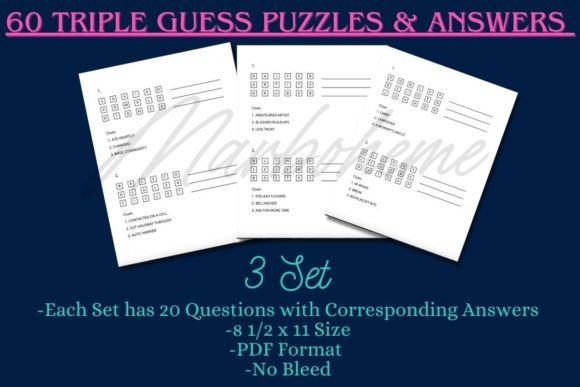
The beauty of this design lies in its scalability. Beginners can take their time, using the clues as gentle guides, while advanced solvers can challenge themselves by attempting to solve all three words within a set time limit. The Triple Guess Puzzle Book Interior – Vol 1 includes 60 such puzzles spread across three distinct packets, each containing 20 challenges. This structure allows users to progress naturally through increasing levels of difficulty or to dip in and out at their leisure without feeling overwhelmed.
Product Highlights That Set Triple Guess Apart
When you invest in a puzzle resource, the details matter. Let's break down exactly what makes Volume 1 of this puzzle book interior stand out in a crowded market.
Triple the Fun, Triple the Engagement
The most immediate highlight is the volume of content. With three complete puzzle packets and 60 individual brain-teasing challenges, users receive substantial value that extends well beyond a single afternoon of entertainment. This abundance makes the collection ideal for sustained use in classrooms, family game nights, or personal relaxation routines. Each packet works as a standalone module, so you can easily assign specific sections to students, take one packet on a trip, or rotate through them to keep the experience fresh.
Complete Answer Keys for Stress-Free Solving
Nothing disrupts puzzle-solving momentum like hitting an insurmountable roadblock with no way forward. The Triple Guess Puzzle Book eliminates this frustration by providing comprehensive answer keys for every single puzzle. These aren't tucked away in some hard-to-find appendix; they're logically organized to let you check solutions quickly. For teachers, this means effortless grading. For self-directed learners, it means the ability to validate answers independently without second-guessing. And for casual solvers, it means you can always peek at a solution, learn from the answer, and move on with confidence rather than lingering in frustration.
PDF Format: The Ultimate in Accessibility
In today's multi-device world, format flexibility isn't just a luxury—it's essential. The PDF format delivery ensures universal compatibility across laptops, tablets, smartphones, and e-readers. You can load the puzzle book onto an iPad for paperless solving with a stylus, print specific pages at home for a traditional pen-and-paper experience, or even project puzzles onto a whiteboard for group activities. This digital format also means you receive instant access without shipping costs or delivery delays, a significant advantage for international users and last-minute lesson planners alike.
Reader-Friendly 8.5x11-Inch Layout
Design matters profoundly when you're staring at a puzzle for concentrated periods. The 8.5x11-inch layout strikes the perfect balance between providing ample white space for notes and keeping the puzzle visually compact enough to process at a glance. Letter sizes are generous without being childish, fonts are clean and distraction-free, and the overall aesthetic supports rather than hinders the cognitive task. This attention to visual ergonomics reduces eye strain and keeps you engaged longer—a critical factor for classroom settings where students may work on multiple puzzles in succession.
Unscramble the Mystery: How the Triple Guess Gameplay Unfolds
The actual solving process deserves deeper examination because it's where the educational magic happens. When you open a Triple Guess puzzle, you encounter three scrambled words. These aren't random; each is cleverly jumbled to obscure its identity while leaving enough structural clues for the attentive solver. Alongside the scrambled letters, you receive three corresponding clues that might be synonyms, categorical hints, or descriptive phrases pointing toward the target words.
Your brain immediately begins a fascinating multi-step process:
- Pattern Recognition: You scan the jumbled letters, identifying common prefixes, suffixes, and consonant-vowel patterns that suggest possible word structures.
- Clue Integration: You hold the clue in working memory while mentally testing candidate words that fit both the semantic hint and the available letters.
- Parallel Processing: Since three words need solving, your brain may simultaneously incubate solutions for all three, bouncing between them as insights emerge.
- Constraint Satisfaction: Once you tentatively solve one word, it reinforces the overall puzzle structure, often providing the mental momentum needed to crack the remaining words.
This process exercises vocabulary recall, spelling accuracy, working memory, and cognitive flexibility—all within a framework that feels like play rather than work. The deductive skills honed here transfer directly to real-world problem-solving scenarios where multiple variables must be considered simultaneously.
Versatile Use: From the Classroom to the Publishing World
The Triple Guess Puzzle Book Interior – Vol 1 wasn't created in a vacuum. It's explicitly designed to serve multiple audiences with distinct needs, making it a remarkably versatile resource.
For KDP Publishers: Ready-Made, High-Quality Content
If you're a Kindle Direct Publishing creator seeking puzzle book interiors that can be quickly formatted into marketable products, this volume presents a turnkey solution. The puzzles are professionally crafted with consistent difficulty curves and clean layouts, allowing you to focus on cover design, marketing, and customer acquisition rather than painstakingly developing original puzzles from scratch. The 60-puzzle volume provides substantial perceived value for end customers. Plus, since the interior is delivered in PDF format designed for 8.5x11-inch pages, adaptation to standard KDP trim sizes is straightforward. You're not just buying puzzles—you're buying time, expertise, and a foundation for a potentially profitable product listing.
For Teachers: Engagement Without the Prep Time
Educators perpetually seek resources that are both educational and genuinely engaging. The Triple Guess puzzles check both boxes while requiring zero preparation time. Use them as warm-up activities at the start of language arts classes, filler tasks for early finishers, or collaborative group challenges that build classroom community. The answer keys enable students to self-check, fostering independence and reducing grading burdens. Because the puzzles target vocabulary and spelling skills, they align naturally with Common Core language standards. The three-packet structure even allows for differentiated instruction: assign Packet 1 to struggling students, Packet 2 to grade-level learners, and Packet 3 to advanced pupils seeking extension activities.
For Puzzle Enthusiasts and Lifelong Learners
Pure enjoyment remains perhaps the most underrated use case. The daily ritual of solving a puzzle or two provides a calming, screen-free mental reset that many adults crave. Unlike doomscrolling social media or watching passive entertainment, puzzle-solving leaves you feeling energized and accomplished. The Triple Guess format, with its layered challenge, offers enough complexity to remain interesting over weeks of regular solving while being accessible enough that you won't abandon it in frustration.
Cognitive Benefits That Extend Beyond the Puzzle Page
The value proposition of the Triple Guess Puzzle Book extends into areas of brain health and cognitive maintenance that researchers have been exploring for decades. While no single puzzle collection constitutes a medical intervention, a growing body of evidence suggests that regular engagement with word-based cognitive challenges contributes to healthy aging and mental acuity.
When you tackle a Triple Guess puzzle, you're activating the language centers of your brain, particularly Broca's area and Wernicke's area. These regions govern speech production and language comprehension, respectively. Regular stimulation of these areas through activities like word unscrambling has been associated with maintained verbal fluency in older adults. Additionally, the problem-solving aspect recruits the prefrontal cortex, your brain's executive command center responsible for planning, decision-making, and moderating social behavior.
Beyond neurobiology, the puzzles cultivate what psychologists call a growth mindset. Each solved puzzle reinforces the belief that challenging problems yield to persistent effort and creative thinking. This meta-skill transfers to professional environments where complex, non-routine challenges increasingly define knowledge work. The patience and systematic thinking practiced during puzzle sessions become habitual, influencing how you approach obstacles in entirely unrelated domains.
Common Misunderstandings About Puzzle Solving
A few misconceptions often prevent people from fully embracing puzzle-based learning and entertainment. Let's address them directly:
- "Puzzles are only for word geniuses." This couldn't be further from the truth. The Triple Guess format is designed with progressive difficulty and includes clues precisely so that solvers of varying abilities can participate successfully. The goal isn't native brilliance but engaged persistence.
- "If I need the answer key, I've failed." Using answer keys is a learning strategy, not a failure. Reviewing a solution you couldn't reach teaches you the word, the clue structure, and the solving approach you missed. That's growth, not defeat.
- "Digital puzzles aren't as good as physical books." The PDF format of this interior allows for both digital and printed use. You can have the exact same experience with a printed stack of papers as you would with a store-bought book—plus the flexibility to reprint pages or solve on a tablet.
Integrating Triple Guess Puzzles into Daily Life
The real power of any puzzle collection emerges through consistent, enjoyable integration into your routine. Here are practical ways to make the Triple Guess Puzzle Book a sustainable part of your day or week:
- Morning mental warm-up: Solve one or two puzzles alongside your coffee to engage your brain before diving into email or meetings.
- Commute companion: If you use public transportation, a printed packet turns dead time into productive engagement.
- Family challenge night: Print copies of the same puzzle and race to see who can solve all three words fastest, then discuss strategies afterward.
- Classroom bell-ringer: Project a puzzle as students enter, giving them the first few minutes to work individually or in pairs.
- Screen-free evening wind-down: Replace at least part of your evening screen time with printed puzzles to improve sleep hygiene.
The key is consistency over intensity. A single puzzle solved with full attention yields more cognitive benefit than rushing through five puzzles distractedly. Allow the process to be meditative rather than pressured.
Why Volume 1 Belongs in Your Collection
The Triple Guess Puzzle Book Interior – Vol 1 earns its place as a valuable resource not through gimmicks but through thoughtful design that respects the solver's intelligence and time. With 60 puzzles, comprehensive answer keys, versatile PDF formatting, and applications spanning personal enjoyment, professional teaching, and commercial publishing, it represents a rare intersection of quality and utility.
In an era when genuine mental challenge often takes a backseat to passive consumption, investing in a resource that actively engages your language centers, problem-solving circuits, and creative thinking pathways feels not just smart but necessary. Whether you're looking to publish your next KDP bestseller, energize your classroom, or simply reclaim quiet moments of focused concentration in a noisy world, this puzzle interior delivers the structure and substance to make that happen.
Take the leap into triple-layered wordplay. Your brain will thank you.