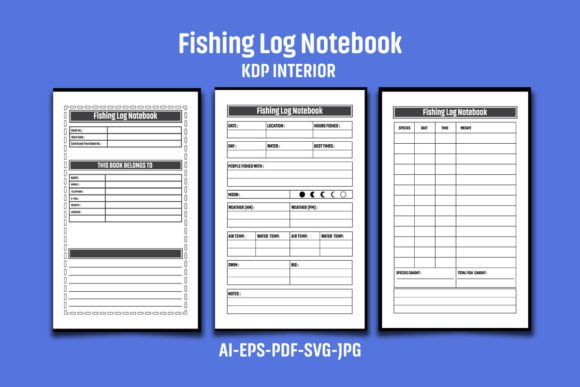
Fishing Log Notebook KDP Interior: A Practical Asset for Self-Publishers Who Value Their Time
Anyone who has built a steady income stream through Amazon KDP knows one truth early on: the more efficiently you can create high-quality interiors, the faster your catalog grows. That’s where a Fishing Log Notebook KDP Interior comes into play — not as a finished book, but as a foundation that removes the heavy lifting from the design process. When you notice fishing journals, logbooks, and record-keeping notebooks consistently ranking in the outdoors niche, the question stops being whether to publish one, and becomes how quickly can you get it live without sacrificing quality. This interior pack answers that question in a remarkably straightforward way.
What This Type of Interior Actually Gives You
Instead of starting from a blank page in Adobe Illustrator or InDesign, you download a compressed folder that contains the entire 110-page layout of a fishing logbook — already sized, spaced, and formatted to Amazon Kindle Direct Publishing’s print standards. The files come as a group: one AI, one EPS, one SVG, one full PDF, and several high-resolution JPGs. Every page is black and white, set to 300 DPI, with the actual book dimensions at 6×9 inches and a bleed-inclusive overall dimension of 6.12 by 9.25 inches. This means when you upload the PDF to KDP, the margins and trim line up correctly without you needing to fiddle with safety zones or bleed settings. It’s not a template that needs heavy tweaking — it’s a production-ready file that only asks for your branding or minor modifications before publishing.
People often ask, “Is this really enough to publish a paperback?” The answer depends on your goals. If you plan to stand out in the fishing log category, you’ll want to open the AI or EPS file and adjust the header typography, insert your own logo, or maybe switch up the interior section labels to match a specific fishing sub-niche — like fly fishing, ice fishing, or saltwater angling. The editable vector files give you that freedom without needing to reconstruct a 110-page document. Once saved as a print-ready PDF, the upload process on KDP becomes a matter of minutes.
Who Gains the Most from a Ready-Made Fishing Log Interior
It’s easy to assume these interiors are only for complete beginners, but that misses several important user profiles.
The first-time KDP publisher who wants to test the waters without investing hundreds in a custom designer will appreciate that the technical specifications are already solved. They can focus on learning the publishing dashboard, running Amazon ads, and researching keywords, rather than spending days learning page layout. With a Fishing Log Notebook KDP Interior, their first product looks polished from day one, which builds confidence and, crucially, avoids expensive proof rejection issues caused by bleed or margin mistakes.
Experienced low-content publishers often use such interiors as a base layer to scale quickly. One creator I spoke with uses interiors like these across multiple niches: swap the fishing log header for a hunting log, a birdwatching journal, or a camping log, and suddenly the same underlying structure powers five different books. The black and white, 6×9 format is so standardized that it acts like a canvas. When you have a sale running on a hunting journal, you can launch the fishing version in a few evenings just by repurposing the interior and designing a fresh cover that matches your brand colors.
Outdoor enthusiasts who are also self-publishers find this interior exceptionally useful. Imagine a fishing guide who runs charters on Lake Michigan. They already have a following and a recognizable logo. Downloading this interior, dropping their logo onto the master page, and maybe personalizing the log fields — like adding a section for water temperature or lure used — results in a branded logbook that they can sell to clients on Amazon or give away as a loyalty perk. It transforms a generic fishing notebook into a signature piece of their business.
Then there’s the stationery brand owner expanding to Amazon. If they’ve built a local customer base for physical notebooks, they can take this digital interior, modify the design to align with their existing aesthetic, and publish under their brand name. Because the interior is fully editable in Illustrator CS6 or newer, they can match paper patterns, add subtle line illustrations, or tweak the page numbers to fit their house style.
Unexpected Ways People Put This Interior to Work
Beyond straightforward publishing, creative applications pop up in places you might not immediately consider. A father who ties his own flies used the interior to create a personalized logbook for his teenage kids. He added a few pages at the beginning with knot-tying diagrams and safety reminders, turning a standard log into a teaching tool that felt like a gift. The editable AI file made it possible to slip those extra pages into the right spot without breaking the overall flow.
Another scenario: a small fishing club wanted a members-only journal to record annual catch data and promote catch-and-release best practices. They altered the interior to include club logo watermarks on every page and a section for recording GPS coordinates of fishing spots (which is a common request). They printed a batch through KDP’s author copies at cost, and distributed them at the club’s annual dinner. The polished look gave the club a professional edge, and the cost per copy was significantly lower than a custom print job from a local shop.
YouTubers and fishing influencers have also found a simple way to build merchandise with minimal risk. Instead of stocking physical inventory, they upload a version of the interior with their channel name tastefully placed in the footer, list it on Amazon, and direct their audience there. When a viewer buys the book, Amazon handles printing and shipping. The influencer collects a royalty, and their audience gets a practical tool. This low-touch model eliminates the headaches of shipping logistics while keeping the brand visible every time someone records a fishing trip.
The Practical Details That Make a Difference
When you unzip the downloaded package, you’ll find the AI, EPS, SVG, PDF, and JPG files all ready to inspect. The fact that it’s 110 pages long isn’t arbitrary — many fishing log interiors in the market range between 100 and 120 pages, hitting a sweet spot where the book feels substantial but not bulky. The 300 DPI resolution ensures that even small text or thin border lines reproduce crisply in print, which is essential because nothing frustrates a buyer more than a blurry interior that looks cheap.
Changing colors is often advertised as a feature, and even though this is a black and white interior, you can subtly adjust the shade of gray used in lines or borders, or modify the stroke weights to create a lighter or heavier feel. Some publishers prefer a slightly softer charcoal instead of pure black for a vintage aesthetic, and the vector files accommodate that with a few clicks.
One often-overlooked advantage is that the layout includes bleed. Interior bleed might seem unnecessary for a simple lined notebook, but when a page design has graphics, borders, or background elements that extend to the edge, having that extra 0.125-inch bleed prevents white slivers from appearing after trimming. It’s a mark of a professionally prepared file, and it saves you the nightmare of resubmitting a corrected file after Amazon’s automated checker flags it.
Common Considerations Before You Hit the Upload Button
A Fishing Log Notebook KDP Interior isn’t a plug-and-play turnkey product that you upload unchanged and then sit back. Amazon actively scans interiors for duplicate content, and if many sellers use the exact same file without any modification, the book can get flagged or even blocked. That’s why the product notes and experienced publishers always stress: add your own logo, graphic, or meaningful design variation to the interior pages before uploading. Even small changes—a custom page border, an altered header font, a subtle background pattern, or reordering the log fields—create enough differentiation to keep your book unique in the eyes of KDP’s review team.
The images, mockups, and any sample text you see in product previews are not part of the download. They serve only to present the product. Your downloaded archive contains the raw interior files — nothing more. So you’ll need to design your own cover separately and ensure your branding on the interior aligns with that cover. For those who enjoy the visual side of publishing, this is an enjoyable creative step. For those less inclined, it’s worth spending a couple of hours finding a cover designer who can complement the interior or using a cover creation tool.
Extracting the ZIP file is generally straightforward — a double-click on Windows or Mac will unpack it, but some users find it helpful to use dedicated software like WinRAR or WinZIP if the default extraction behaves oddly. Once extracted, you’ll need vector-editing software to make the most of the AI or EPS files; free alternatives like Inkscape can open them, though Adobe Illustrator is the native environment. The PDF can serve as a quick reference or be used directly if you’re 100% satisfied with the design as is, but that’s rare for serious publishers who care about brand distinction.
What to Watch for When Customizing
The 6×9 format is enormously popular, but if your audience research shows a preference for a larger 8.5×11 format or a compact 5×8 size, you’d need to rebuild the interior manually. Resizing a 110-page document without affecting alignment is tedious, so it’s often wiser to start with the right dimensions from the outset. This interior pack is locked into the 6×9 standard, which covers a massive portion of the KDP marketplace but isn’t universally ideal.
Black and white interiors keep printing costs low, which means you can price your book competitively while maintaining a reasonable royalty. However, if your fishing log concept demands vibrant illustrations of fish species, river maps, or color-coded sections, this interior won’t serve you. Color interiors on KDP cost significantly more to produce, and the royalty math shifts accordingly. Many successful publishers in the outdoors niche stick to black and white precisely because it keeps the list price attractive — often under ten dollars — and still delivers a handsome profit per sale.
Another subtle point: the interior is built for CS6 versions of Illustrator, which are older but still capable. If you’re on the latest Creative Cloud, the files open without issue, but some legacy effects or fonts might prompt a warning. Usually, that’s harmless, but it’s worth checking that no text reflows after opening. A quick export to PDF and a glance through a few random pages usually confirms everything is intact.
Where This Tool Fits into a Broader Low-Content Strategy
Think of this interior as a building block, not the whole house. Many thriving KDP businesses operate by taking a robust, well-formatted interior and then layering on a unique angle — a specific fishing method, a particular region, a humorous tone, or even a tie-in with a seasonal event like “2025 Bass Season Log.” Because the heavy work of page numbering, margin setup, and grid alignment is done, you can spend your creative energy on market research and branding. One publisher told me they launch a new version of their fishing log every spring with a different cover theme and slightly adjusted internal prompts, and they’ve built a loyal following that expects the annual update.
From a time-efficiency perspective, what usually takes a week of nights — setting up master pages, aligning text frames across 110 pages, checking bleed — gets compressed into a single evening of minor edits. That time saving compounds when you manage multiple niches. A Fishing Log Notebook KDP Interior becomes a reusable asset; once you’ve customized it for fishing, you can duplicate your customized version, change a few words, and suddenly you have a boating log, a kayaking trip journal, or a diving record. The underlying structure serves many purposes, which is exactly the kind of thinking that separates a hobbyist from a full-time publisher.
A Look at the Actual Workflow
Downloading and extracting the ZIP gives you immediate access to all file types. The AI and EPS files are your editable masters. Open one, and you’ll see the entire 110-page spread in one document, with layers that let you toggle elements on or off. A typical sequence might be: duplicate the header layer, change the text “Fishing Log” to your own phrase, insert a tasteful monogram logo on the footer, adjust the date field label if you prefer “Angling Date” over “Date,” and then export to a PDF with KDP’s trim size and bleed settings. The built-in JPGs can serve as quick previews to place inside mockups while you’re waiting for the author proof, which helps when building your Amazon listing images.
There’s a certain satisfaction that comes from holding that first author copy in your hands, seeing clean, sharp lines and a layout that feels like a real book you’d find in an outdoor store. Knowing that the interior underpinning it was quite literally a download and a few edits away makes the whole process feel less like a technical grind and more like a creative sprint.
Ultimately, the real value of a Fishing Log Notebook KDP Interior isn’t just the file set — it’s the runway it gives you. Whether you’re a beginner with a single book idea or a seasoned publisher looking to fill out a niche catalog, having a production-ready interior removes the friction that often kills momentum. It lets you focus on what actually sells books: understanding what anglers want to record, creating a cover that stops a scroller, and writing a description that converts a browser into a buyer. The interior itself becomes the quiet, reliable backbone that makes all of that possible.