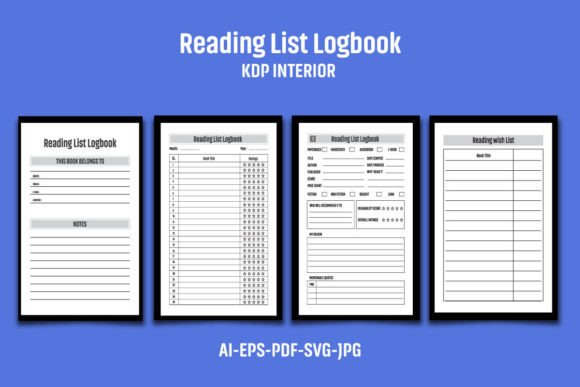
Reading List Logbook KDP Interior
A well-designed reading log brings structure to the chaotic joy of falling in love with one book after another. For self-publishers on Amazon KDP, offering a practical, beautiful book tracker can turn into a dependable passive income stream—and the Reading List Logbook KDP Interior gives you the exact blueprint to make that happen. It’s a ready-to-use template package designed to help you launch a professional low‑content book without starting from scratch.
Instead of wrestling with layout decisions, size guides, or bleed margins, you get an instantly adaptable 110‑page interior. The files are built for the popular 8.5×11 inch trim size—a format that feels spacious yet fits comfortably on bookshelves. This template works like a design partner that hands you the structure, so your energy goes into branding, personalization, and connecting with the right readers.
What Makes This KDP Interior Different
Many generic logbook templates force you to accept rigid layouts. This package stands out because it provides true editable source files: an AI file, an EPS, an SVG, plus ready‑to‑print JPGs and a high‑resolution PDF. You get full creative control over every line, table, and border. The artwork is set at 300 DPI, which guarantees crisp output when Amazon prints the book. Black‑and‑white interiors are ideal for KDP’s royalty structure, and the template’s clean lines stay sharp even on cream paper.
Every page includes a properly calculated bleed, extending the final dimensions to 8.62 x 11.25 inches. That small technical detail prevents ugly white slivers at the edges of a printed book—something that often trips up first‑time publishers. With the bleed already embedded, you can export your finished design confidently and upload directly.
Building a Reading Trackers That Sells
Book lovers log their reads for vastly different reasons. A graduate student needs to track academic citations and themes. A romance reader wants to remember favorite tropes and steam levels. A parent compiling a summer reading challenge for kids looks for reward stars and colorful checkboxes. The Reading List Logbook KDP Interior gives you a flexible starting point that morphs into any of these. You keep the core grid structure while layering personality around it.
Think beyond the bare bones “title and author” column. Adapt the page to include sections for:
- Genre, format, and date completed – helps readers spot patterns in their habits.
- Rating systems – from simple star outlines to numeric scales or descriptive word banks.
- Notes on quotes, characters, and worldbuilding – a quick-reference canvas for book clubs.
- Reading challenges – mini progress bars or checklists that turn logging into a game.
By making these small tweaks, you move from “another reading journal” to a niche tool that feels custom‑built for a specific audience—and that specificity often leads to better reviews and higher perceived value.
Design Variations Without Overcomplication
Because the source files are layered and editable in Adobe Illustrator (CS6 or later), you can experiment with style while preserving the page count and flow. Here are a few directions that work beautifully while keeping the layout easy to navigate:
- A minimalist version with thin hairline borders, generous white space, and a single serif font. This appeals to bullet journal enthusiasts and readers who want an elegant keepsake.
- A bold graphic edition that uses thick decorative headers, chapter‑inspired corner elements, or subtle storybook silhouettes. Perfect for fantasy or young adult niches.
- A guided journal hybrid that sprinkles reflective prompts between log pages—questions like “Which character would you have tea with?” or “What song captures the mood of this book?”. This turns a simple tracker into an interactive experience.
The monochrome requirement doesn’t limit you. Varying the stroke weight, adding stippled shading, or weaving in ornamental dividers creates depth. You can also convert fonts to outlines and slightly stylize them without violating KDP’s guidelines.
Practical Customization Steps That Protect Your Listing
Amazon’s system may flag interiors that appear identical to other sellers. The smart move—required by this template’s license—is adding your own logo or graphic before uploading. This isn’t a frustrating extra step; it’s a chance to brand every spread. Place a subtle watermark of your publishing imprint on the footer, or tuck a small icon into the page header. Even a repeated geometric motif makes the interior uniquely yours and reduces the risk of duplicate content flags.
Here’s a solid workflow for working with the downloaded ZIP:
- Extract all files using WinZIP, WinRAR, or your operating system’s built‑in tool. You’ll find the AI, EPS, SVG, PDF, and JPG folders.
- Open the AI or EPS file in Illustrator. The CS6 compatibility means older software won’t reject the file.
- Edit global colors if needed—though the template is designed for black and white, you can tweak the richness of the black or add grayscale accents for a softer feel.
- Insert your custom graphic on the first page, repeating it consistently across all pages if desired.
- Export a new print‑ready PDF with the exact same dimensions and bleed settings. Always double‑check that your PDF still contains 110 pages.
That final export is what you’ll upload to KDP. Since the original PDF already meets spec, your version inherits all the correct trim and margin values. This “edit‑a‑copy” method keeps your production time minimal—often under an hour from extraction to finish.
Who Uses These Interiors Successfully
The beauty of a reading list logbook template is its broad appeal across creator types. Coaches and educators create versions that pair with their course reading lists. Bookstagrammers and BookTok influencers design branded journals they sell alongside themed merchandise. Freelance graphic designers offer customized logbook creation as a one‑off service to authors and publishers. Even hobbyists who love to tinker turn a simple template into a series of seasonal reading journals—spring‑themed, cozy autumn, or holiday countdown editions.
For a small business owner, this template becomes a launchpad. You can build a collection of low‑content books without hiring a designer for every fresh idea. Once you understand the editing rhythm, you can replicate the process for recipe journals, travel diaries, or habit trackers—all starting from a layout that already respects KDP’s technical demands.
Making Your Reading Journal Stand Out in a Crowded Market
A quick Amazon search shows thousands of reading logs. To rise above, concentrate on two things: interior harmony and a promise that resonates. The template gives you visual harmony through consistent spacing and alignment; your job is to infuse meaning. Write a product description that doesn’t just list features but speaks to a reader’s identity. For example, a “Mystery Lover’s Case File” logbook uses detective‑themed headers and promises to turn every read into a solved case. A “Reader’s Reset” journal frames logging as a mindfulness practice, with gentle lettering and quotes about slowing down.
Using the scalable SVG file, you can easily adjust elements for a paperback cover that matches your interior style. Even a small icon repeated from the inside pages creates a cohesive brand—something readers appreciate and that prompts repeat purchases when you launch another journal.
The Reading List Logbook KDP Interior isn’t a finished product; it’s your creative skeleton key. With 110 well‑structured pages and print‑ready specifications, it removes the technical friction so you can focus on what book lovers genuinely need. Personalize it, niche it down, and present it as a thoughtful companion for someone’s reading life. That’s the difference between a forgotten interior file and a journal that quietly earns royalties while you sleep.