The Strategic Value of an Employee Verification Letter in Modern HR Operations
Human resources documentation has evolved far beyond simple paper trails and filing cabinets. Today, an Employee Verification Letter represents more than a routine administrative task—it stands at the intersection of compliance, trust, and operational efficiency. Whether you manage a small creative agency, run a growing freelance network, or oversee HR for a scaling enterprise, these documents carry weight that extends into lending decisions, tenant approvals, immigration processes, and professional credentialing. Understanding how to craft, manage, and deploy verification letters effectively can transform a mundane workflow into a strategic advantage.
The landscape of employment confirmation has shifted dramatically. Remote and hybrid work models have dispersed teams across jurisdictions, making standardized Employment Confirmation Letter templates and Employee Salary Verification Forms essential for consistency. Lenders, property managers, and government agencies increasingly demand precise, professionally formatted Income Verification Documents that meet specific formatting and content requirements. This isn't simply about confirming that someone works somewhere—it's about creating a reliable, repeatable system that protects both the organization and the employee while satisfying third-party scrutiny.
What an Employee Verification Letter Actually Communicates
At its core, an Employee Verification Letter serves as an official statement from an employer confirming an individual's employment status, tenure, position, and often compensation details. But the document's true function extends deeper. It acts as a formal bridge between the employer's internal records and the external world's need for validation. Banks processing mortgage applications, landlords evaluating rental applications, and consular officers reviewing visa requests all rely on these letters to make consequential decisions. The quality, clarity, and professionalism of the letter directly influence how those decisions unfold.
A well-constructed Salary Verification Letter does more than list numbers. It contextualizes earnings, distinguishes between base pay and variable compensation, and provides the necessary framing for accurate financial assessment. When an employee applies for a mortgage, for instance, the difference between stating a base salary versus including overtime, bonuses, or commission structures can significantly impact loan qualification. HR professionals who understand these nuances create documents that serve their employees' real-world needs without overstepping disclosure boundaries.
The Anatomy of Effective HR Verification Resources
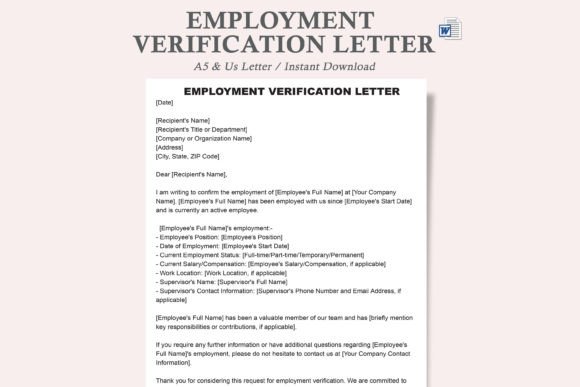
Professionals working with HR Forms and Templates understand that structure matters. An effective verification letter typically includes the employer's letterhead, the date of issuance, the recipient or "to whom it may concern" designation, the employee's full name, job title, employment dates, and—where appropriate—salary information. But the difference between adequate and excellent often lies in the details: clear contact information for follow-up verification, precise language that satisfies legal requirements without creating unintended obligations, and formatting that projects institutional credibility.
The growing availability of HR Verification Resources reflects a market responding to complexity. Organizations no longer need to draft these documents from scratch or rely on inconsistent approaches across departments. Standardized templates—available as editable Word templates, printable PDFs, and editable PDFs in multiple sizes like A5 and US Letter—allow HR teams to maintain consistency while adapting to specific requirements. This standardization reduces errors, speeds up response times, and ensures that every verification letter leaving the organization meets the same professional benchmark.
Why Employee Salary Validation Matters Now More Than Ever
The rising attention on Employee Salary Validation reflects broader economic and social shifts. In an era of increased financial scrutiny, tightened lending standards, and growing gig economy participation, verified income has become a cornerstone of economic mobility. Freelancers and contract workers, in particular, often face hurdles when their income streams appear irregular or difficult to document. For traditional employees, the ability to quickly obtain a properly formatted Salary Verification Request response can mean the difference between securing a lease or losing an opportunity.
Organizations that treat salary verification as a strategic service rather than an administrative burden gain a subtle but meaningful competitive edge in talent retention. When employees know their HR department can rapidly produce professional, accurate Verified Income Letters, it reduces stress during major life events—home purchases, rental applications, adoption processes, or international relocations. This reliability becomes part of the employment experience, contributing to the perceived quality of the organization's support infrastructure.
Digital Transformation and Documentation Workflows
The digitization of HR processes has reshaped expectations around verification documents. What once required in-person requests and multi-day turnaround times now often happens through self-service portals and automated systems. However, the human element remains critical. Automated systems can populate data fields, but they cannot always discern when a customized letter better serves the employee's circumstances or when nuanced language protects the organization from liability. The most effective Human Resources Documentation approaches blend automation with human oversight, using templates as starting points rather than rigid endpoints.
This shift toward digital-first workflows has also elevated the importance of document design. A professional, minimalist, ink-friendly design isn't merely aesthetic—it ensures that verification letters print cleanly across various devices and settings, maintain legibility when scanned or photocopied, and project the polished image that financial institutions and government agencies expect. Organizations increasingly recognize that document presentation affects perception, and perception affects outcomes.
Connecting Verification Practices to Broader Industry Trends
The emphasis on Employment Verification Letter quality connects directly to larger movements in compliance, data privacy, and employee experience design. Regulatory frameworks across jurisdictions impose specific requirements on what employers can and cannot disclose. Some regions restrict the inclusion of salary details without explicit employee consent. Others mandate specific language around at-will employment or probationary periods. Organizations operating across state or national boundaries need templates flexible enough to accommodate these variations while maintaining core consistency.
Data privacy concerns also shape modern verification practices. The rise of identity theft and social engineering attacks means HR departments must verify the legitimacy of verification requests before releasing sensitive information. Best practices now often include confirming the request directly with the employee, using secure transmission methods, and limiting disclosed information to what is strictly necessary for the stated purpose. These practices protect both the employee and the organization while demonstrating the kind of conscientious data handling that regulators and consumers increasingly demand.
The Creator Economy and Non-Traditional Employment
The expansion of the creator economy, freelance platforms, and project-based work has introduced new complexity to income verification. Traditional Income Verification Documents designed for salaried employees often fail to capture the reality of variable, multi-source income streams. Forward-looking organizations, including platforms that serve independent workers, are developing verification frameworks that aggregate earnings across clients and projects, providing a more accurate picture of financial stability. This evolution reflects a labor market where the boundaries between traditional employment and independent work continue to blur.
For entrepreneurs and small business owners, the ability to issue professional verification letters for their teams—even small ones—signals operational maturity. A thoughtfully designed Employment Confirmation Letter template, maintained consistently and customized appropriately, communicates to employees, partners, and external stakeholders that the organization takes its responsibilities seriously, regardless of its size.
Practical Approaches to Building a Verification System
Organizations looking to improve their verification processes should start with an honest assessment of current practices. How long does it take to fulfill a typical verification request? Are letters consistent in format and language? Do employees know how to request verification documents? Are templates available in the formats and sizes needed—A5 for international correspondence, US Letter for domestic use, editable Word templates for customization, and printable PDFs for quick, standardized responses?
The most effective systems combine clear internal policies with accessible, well-designed resources. HR teams benefit from maintaining a library of HR Forms and Templates that cover common scenarios: standard employment verification, salary-specific verification, verification for immigration purposes, and verification that addresses specific lender requirements. Each template should be reviewed periodically for legal compliance and relevance, ensuring that the organization's verification practices evolve alongside regulatory changes and business needs.
Design Considerations That Influence Credibility
Document design plays a surprisingly significant role in how verification letters are received. A clean, professional layout with appropriate use of whitespace, consistent typography, and restrained branding elements signals attention to detail and institutional seriousness. The availability of templates designed to be ink-friendly recognizes the practical reality that many recipients will print these documents, often in black and white. Thoughtful design accounts for this, ensuring that critical information remains clear and legible regardless of the output medium.
The option to print a new page every time you need more reflects the operational reality of HR work—verification needs are ongoing and unpredictable. Digital downloads that can be accessed, customized, and printed on demand eliminate the inefficiency of maintaining physical inventory while ensuring that the most current version of any template is always in use. This approach supports both distributed teams and centralized HR functions, accommodating the diverse working models that characterize contemporary organizations.
The Human Element in Administrative Precision
Despite the availability of sophisticated HR Verification Resources and automated systems, the human dimension remains central. Every verification letter represents a real person navigating a significant life moment—securing housing, purchasing a home, pursuing educational opportunities, or relocating for a new chapter. HR professionals who approach these documents with an understanding of their impact create better outcomes for everyone involved. The template is the tool; empathy and attention to detail are the craft.
Organizations that invest in high-quality Employee Verification Letter processes—from template design to request handling to quality review—build trust that extends beyond individual transactions. Employees who experience smooth, professional verification support carry that positive impression into their broader relationship with the organization. External parties who receive clear, accurate, well-presented letters develop confidence in the organization's reliability. In a business environment where trust is both precious and fragile, these seemingly small interactions accumulate into meaningful reputation effects.
As the nature of work, employment relationships, and financial verification continues to evolve, the organizations that thrive will be those that treat documentation not as bureaucratic overhead but as an expression of their operational values. The tools exist—editable templates, printable formats, digital downloads in multiple sizes—but their effectiveness depends entirely on the thoughtfulness with which they are deployed. An Employee Verification Letter, ultimately, is more than a form. It is a statement about how an organization sees its people, its obligations, and its place in the broader ecosystem of trust that enables economic life to function.