Versatile Puzzle Book Interior Bundle: Avoid the Common Pitfalls Before You Publish
You’ve found a ready-to-use collection of puzzles and you're eager to turn it into a book for KDP, a classroom resource, or a side project. The Versatile Puzzle Book Interior Bundle promises exactly that—a mix of Sudoku, word searches, and mazes, all delivered as printable PDFs. But before you hit upload or press print, there are a few overlooked details that can quietly turn a promising project into a disappointing experience. This isn't about doubting the quality of the bundle. It's about using it with clear eyes, so you avoid the tiny missteps that trip up even seasoned creators.
What the Bundle Actually Solves
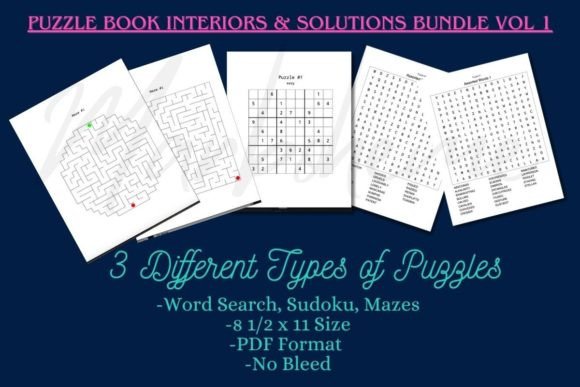
For anyone who has ever stared at a blank page trying to design a Sudoku grid or manually align maze paths, this kind of interior bundle saves hours. You get 30 Sudoku puzzles across easy, medium, and mixed levels, each with its own solution section. There are 40 word search puzzles split into two clean packets, and three distinct maze styles—circle, diamond, and square—with 10 puzzles each. The format is straightforward: PDF, 8.5 x 11 inches, ready to slip into your publishing software or print stack. In theory, it's a massive time-saver. In practice, the difference between a polished final product and a frustrating mess often comes down to how you handle what's inside.
Where Creators Often Stumble—Even With Great Interiors
I've watched dozens of people buy puzzle interiors, excited to launch a low-content book, only to run into complaints about "missing pages" or "puzzles are too hard." The root cause is rarely the bundle itself. It's usually a mismatch between how the product is presented and how the user imagines it will work. Let's walk through the most frequent oversights, and more importantly, how to correct them before they become a problem.
Assuming Print-Ready Means Perfect for Your Project
The files are sized at 8.5 x 11 inches, which is standard. But when you upload to KDP, your chosen trim size might be different—maybe 6 x 9 inches or 8 x 10 inches. If you simply insert the pages without adjusting margins or bleeding, you could end up with puzzles that are cropped or too close to the binding. I've seen word search puzzles where the word list gets swallowed by the spine. Always set your document dimensions to match your intended trim size and check how each puzzle sits on the page. A five-minute visual scan can prevent a flood of returns.
Skipping the Solutions Check
The bundle includes solution packets for Sudoku and word searches—that's excellent. But I've noticed that some beginners place all solutions at the back without clearly indicating which puzzle they correspond to. If the puzzle says "Sudoku 5" and the solution section just lists grids without labels, you'll confuse the reader. Take the time to match every puzzle to its solution, and add a simple page number or title if needed. For the mazes, there might not be explicit solutions included. Double-check this. If you need to show the solution path, you can quickly draw it on a separate page. Never assume the end user will "figure it out"—they expect clarity.
Overlooking the Mix of Difficulty Levels
The Sudoku section includes easy, medium, and mixed levels, 10 puzzles each. That’s a thoughtful spread. However, a common mistake is to market the book as "for all ages" without testing whether your target audience actually finds the mixed-level pack accessible. A mixed-level packet might randomly jump from a very easy puzzle to a devilishly hard one. If you're designing for seniors, for example, test a few puzzles from the mixed set yourself. If the difficulty spikes too abruptly, consider rearranging the order so the book flows gently from easy to challenging, rather than rattling the solver. This small editorial touch dramatically improves user satisfaction.
Not Customizing the Word Search Themes
Forty word searches pre-made are a gift, but if all the puzzles feature generic word lists like "animals" or "countries" without a unifying theme, your book may feel like a grab-bag instead of a cohesive product. You can absolutely use the bundle as a base. Open the PDF in a tool that allows text editing and consider swapping a few word lists to fit a niche—like "kitchen vocabulary" for a cooking-themed book, or "classroom objects" for a teacher resource. You don't need to rebuild the grid. Even a few tweaks signal that you've put thought into the final book, making it more attractive than a directly reprinted interior.
Formatting Details That Matter More Than You Think
PDFs are convenient, but they can behave differently when loaded into a KDP manuscript. The Versatile Puzzle Book Interior Bundle is designed to be simple, yet I've seen creators forget to embed fonts or flatten layers. If your PDF contains text-based puzzle grids and you don't embed the font, Amazon's print process might substitute a different font, altering the alignment. Always open the file in a professional application like Adobe Acrobat or Affinity Publisher and confirm that text is outlined or fonts are embedded. For the mazes, which are likely vector or image-based, ensure they remain at 300 DPI when scaled. If you shrink a page to fit a 6 x 9 trim without resolution checks, the maze lines can look fuzzy—a quick way to get negative reviews.
The Danger of Duplicate Content on KDP
KDP's guidelines are strict about duplicate interiors. If you take this bundle and publish it as-is with a different cover, you risk having your book flagged. The solution isn't to avoid the bundle—it's to add value. Replace some puzzles with your own, add a few blank pages for notes, write an introduction, or combine the puzzles into themed sections with dedicated title pages. A unique table of contents, author page, or bonus section at the end transforms the book from a simple reprint into something that respects both KDP's rules and your customers' expectations. As a general rule, never rely on the interior alone to carry your book's identity.
Making the Most of the Bundle as a Teacher or Facilitator
If you're buying this for classroom or workshop use, you have different concerns. The 8.5 x 11 inch format is ideal for photocopying, but check your printer's tolerance for borderless printing. Many printers crop a thin margin around the edge. If the maze paths or word search edges run too close to the paper boundary, they'll get clipped. Before printing a whole set for 30 students, run a single test page to confirm the entire puzzle prints cleanly. For reusable purposes, consider laminating the puzzles or slipping them into dry-erase sleeves—the PDF's crisp lines will hold up perfectly without bleeding.
When Solutions Aren't Enough
The bundle gives you answer keys, which is fantastic for self-checking. But if you're using these puzzles in a classroom, you might want to provide hints instead of full solutions. Slicing the solution section apart using a free PDF splitter allows you to hand out answer sheets only to instructors, keeping the challenge intact for students. A thoughtful move like that turns a generic interior into a tailored teaching tool.
What to Verify Before You Invest Your Time
Before you design an entire book around the Versatile Puzzle Book Interior Bundle, take 15 minutes to run a checklist. Open every file. Are there any broken lines in the mazes? Do all Sudoku puzzles actually have a unique solution? (Rare, but it happens even in reputable bundles.) Try solving one puzzle from each level to gauge the true difficulty. If you're publishing on KDP, upload a sample to the Previewer tool and look at every page. What looks fine on screen may reveal ghosting or alignment issues in print. These are small, preventive steps that separate a professional product from an amateur one.
Avoiding the "More Is Better" Trap
With 30 Sudoku, 40 word searches, and 30 mazes, the temptation is to cram everything into one book to maximize page count. But a 100-page puzzle book with no breathing room can feel overwhelming. Consider splitting the content into two or three smaller books, each with a focused theme. For example, one book could be "Beginner Sudoku & Word Search," another "Challenging Mazes & Mixed Puzzles." This not only helps you target different audiences but also creates multiple revenue streams from a single bundle. The bundle's versatility lies in how you choose to deploy it—not just in the variety of puzzles it offers.
Real-World Example of a Better Approach
Imagine a KDP publisher, Maria, who downloads the bundle and immediately publishes a 150-page puzzle book titled "Ultimate Puzzle Collection." No cover design thought, no internal branding. Six months later, she wonders why sales are flat. Compare that to another creator, Tom, who takes the same bundle, removes 10 puzzles to create space for a brief introduction on "How to Approach Sudoku Strategy," adds a personal note on each maze page about staying calm while solving, and designs a cover that speaks directly to adults looking for rainy-day relaxation. He also separates solutions into a clearly marked section at the back with a short note on how to use them. Tom's book feels intentional. The interior same bundle becomes a supporting actor, not the star of the show.
Your version doesn't need to include strategic advice. It could simply be a well-paced collection, with consistent formatting and a few custom pages that make the book unmistakably yours. When you treat the interior as raw material rather than a finished book, you elevate everything.
Staying on the Right Side of Copyright and Quality
The Versatile Puzzle Book Interior Bundle is meant for KDP self-publishing and teacher resources. That implies a broad license, but you should still confirm the terms of use: can you resell the puzzles as part of a digital app, or only in printed form? Are you allowed to modify the puzzles? Most bundles of this type grant you the right to use the content in your own created books, but not to resell the source file as a PLR product. Respecting those boundaries keeps your business safe. And always, always add some form of visible difference—a new title page, a different arrangement of sections—so that your final book isn't identical to someone else's who bought the same bundle. Small-scale customization is the simplest form of protection.
When used thoughtfully, these puzzle interiors are a fantastic shortcut. They handle the tedious part of creating new puzzles from scratch, freeing you to focus on design, packaging, and reaching your audience. Just remember that the bundle is a starting point, not a finished destination. Keep your end user in mind, double-check every page, and don't be afraid to rearrange or supplement. Those quiet corrections are what turn a generic download into a product people actually enjoy, recommend, and come back to for more.